
What is mental health?
Mental health refers to a person’s overall wellbeing and capacity to cope with the normal stresses of life, to realize their skills and abilities, and to contribute to their community. Mental health can be impacted by internal and external influences, including social, psychological, spiritual, and biological factors. For example, physical health, including having a chronic disease like arthritis, is a biological factor that can influence mental health. The reverse is also true – mental health can have an impact on physical health, too.
Both physical and mental states contribute to your overall health and wellbeing. Physical health is the state of your body, and mental health is the state of your mind, feelings, and emotions. In the same way that your physical health can fluctuate, so can your mental health. Some days you might feel better than others. Sometimes you may feel unwell for a few days, like when you have a cold or when you’re sad about a current situation, but then feel better.
What is a mental health condition?
Mental health and mental health conditions are related but distinct concepts. Mental health refers to your state of being, while mental health conditions are disorders that are characterized by alterations in thinking, mood, and behaviour that are associated with significant distress and impaired functioning.
Similar to a chronic physical health condition, a mental health condition may not go away but can often be treated and managed well. Some of the most commonly experienced mental health conditions among people living with arthritis are depression (affecting about 3 in 10 people living with arthritis), and anxiety disorders (affecting about 2 in 10 people living with arthritis).
It is important to note that it is possible to maintain good mental health even if you live with a mental health condition. Just like with other health conditions, many people with mental health conditions experience tough times, but they can also have periods of better mental health when other conditions are being managed well. It can be helpful to think about mental health and mental health conditions as existing on two continuums that intersect one another.
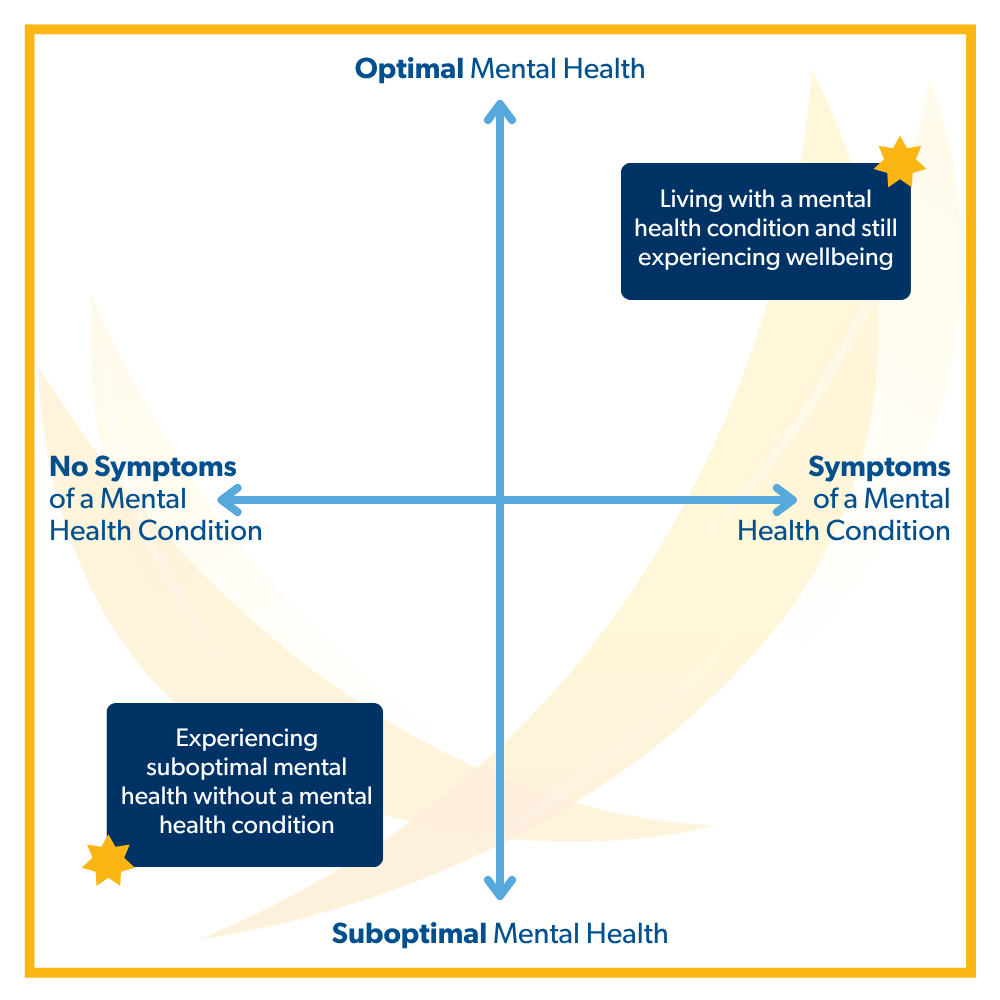
Image adapted from Canadian Mental Health Association Ontario
Visualize this continuum chart as a large square spit into four smaller squares, or quadrants, with one line running through the middle from top to bottom, and one line running through the middle from side to side.
The mental health condition continuum runs side to side from experiencing “no symptoms of a mental health condition” at one end to experiencing “symptoms of a mental health condition” on the other.
The mental health continuum runs top to bottom from experiencing “optimal mental health” at one end, and at the other end is experiencing “suboptimal mental health.”
Your personal experience can be placed within any quadrant within the continuum, factoring in what you are experiencing and where you are located on either continuum line.
Someone can have a mental health condition and have optimal mental health, and someone else can experience suboptimal mental health without having a mental health condition. Each quadrant represents a range of different experiences.
Stigma

There can be a lot of pressure in today’s society to portray a happy, successful version of ourselves, and a great deal of stigma remains around acknowledging feeling sad, overwhelmed, or afraid — let alone living with a mental health condition. Stigma is when someone is judged for who they are as a person, the things they experience in life, or the choices they make. When talking about mental health, stigma refers to the negative attitudes, beliefs, and stereotypes associated with people who are dealing with mental health concerns.
Feeling shame about their mental health can stop people from reaching out for help, often leading to greater concerns in the long term – and some people report that stigma is worse than the mental health concerns. Discrimination for other reasons (including, but not limited to, culture, race, ethnicity, faith, disability, sexuality, or gender identity) can also impact mental health, and people who face this discrimination often have a more difficult time accessing appropriate mental health support in a setting that feels safe.
Ending stigma is crucial, as detailed in the Lancet Commission report on ending stigma and discrimination in mental health (2022). This report highlights the important role that people with lived experiences play in reducing stigma (e.g., through peer support). Having more discussions about mental health in a kind, non-judgmental way can help to reduce this stigma.
Cultural Considerations
 Cultures and families can play a big part in the way people think about and understand health and wellness, especially mental health. Perceptions of how people behave and think varies from culture to culture. What one community may view as a problem, weakness, or sign of misfortune, another might view in a positive way – such as a special ability, spiritual experience, or a demonstration of resilience – and another still might view as a normal part of life.
How people choose to seek help may also be linked to culture. Some people may prefer to talk with family members, Elders, or other trusted leaders in their community rather than a medical doctor or mental health professional. Others may prefer to talk to someone outside of their cultural group, or they may not want to talk to anyone. Certain approaches to treatment or management may be practiced more often in some cultures too, such as healing ceremonies and traditional medicines.
Contributors
This mental health resource was developed and last reviewed in March 2026 with expert advice from:
Dr. Joshua A. Rash, PhD, RPsych (NL), R.D.Psych. (SK)
Memorial University of Newfoundland; University of Saskatchewan
Marg Smit-Vandezande, MSW, RSW
Arthritis Rehabilitation and Education Program, Arthritis Society Canada
Nikolas Harris, MSW, RSW
Senior Manager, Mission, Arthritis Society Canada
- Mental health. World Health Organization. https://www.who.int/health-topics/mental-health.
- Aaron RV, Ravyts SG, Carnahan ND, et al. Prevalence of Depression and Anxiety Among Adults With Chronic Pain: A Systematic Review and Meta-Analysis. JAMA Netw Open. 2025;8(3):e250268. Published 2025 Mar 3. doi:10.1001/jamanetworkopen.2025.0268. https://pubmed.ncbi.nlm.nih.gov/40053352/.
- The Difference Between Mental Health and Mental Illness. HelpStartsHere. February 18, 2026. https://helpstartshere.gov.bc.ca/blog/difference-between-mental-health-and-mental-illness.
- Positive Mental Health and Well-Being. Canadian Mental Health Association Ontario. https://ontario.cmha.ca/documents/positive-mental-health-and-well-being/.
- Keyes CL. The mental health continuum: from languishing to flourishing in life. J Health Soc Behav. 2002;43(2):207-222. https://pubmed.ncbi.nlm.nih.gov/12096700/.
- Stigma. HelpStartsHere. May 23, 2023. https://helpstartshere.gov.bc.ca/wellbeing/social/stigma.
- Thornicroft G, Sunkel C, Alikhon Aliev A, et al. The Lancet Commission on ending stigma and discrimination in mental health. Lancet. 2022;400(10361):1438-1480. doi:10.1016/S0140-6736(22)01470-2. https://www.thelancet.com/journals/lancet/article/PIIS0140-6736(22)01470-2/abstract.
- Addressing Mental Health Stigma in Diverse Cultural Communities. ConnexOntario. January 7, 2025. https://connexontario.ca/blog/mental-health-stigma-diverse-cultures/.
- Understanding Mental Health Care For People With Arthritis. Arthritis Research Canada. https://www.arthritisresearch.ca/mental-health-care-highlight/.
- Goel N, Wallace EB, Lindsay C. Hot Topics: Depression in Individuals With Psoriasis and Psoriatic Arthritis. J Rheumatol. 2024;51(Suppl 2):43-50. Published 2024 Oct 1. doi:10.3899/jrheum.2024-0362. https://pubmed.ncbi.nlm.nih.gov/39009389/.
- Wang ST, Ni GX. Depression in Osteoarthritis: Current Understanding. Neuropsychiatr Dis Treat. 2022;18:375-389. Published 2022 Feb 22. doi:10.2147/NDT.S346183. https://pmc.ncbi.nlm.nih.gov/articles/PMC8883119/.
- Stubbs B, Aluko Y, Myint PK, Smith TO. Prevalence of depressive symptoms and anxiety in osteoarthritis: a systematic review and meta-analysis. Age Ageing. 2016;45(2):228-235. doi:10.1093/ageing/afw001. https://pubmed.ncbi.nlm.nih.gov/26795974/.
- Sharma A, Kudesia P, Shi Q, Gandhi R. Anxiety and depression in patients with osteoarthritis: impact and management challenges. Open Access Rheumatol. 2016;8:103-113. Published 2016 Oct 31. doi:10.2147/OARRR.S93516. https://pmc.ncbi.nlm.nih.gov/articles/PMC5098683/.
- Murphy LB, Sacks JJ, Brady TJ, Hootman JM, Chapman DP. Anxiety and depression among US adults with arthritis: prevalence and correlates. Arthritis Care Res (Hoboken). 2012;64(7):968-976. doi:10.1002/acr.21685. https://pubmed.ncbi.nlm.nih.gov/22550055/.
- Staying Healthy with Arthritis: Body AND Mind. Johns Hopkins Arthritis Center. August 15, 2012. https://www.hopkinsarthritis.org/arthritis-news/staying-healthy-with-arthritis-body-and-mind/
- Arthritis & Mental Health: It’s Complicated. Arthritis Research Canada. https://www.arthritisresearch.ca/understanding-rheumatoid-arthritis-and-mental-health/.
- Howren A, Sayre EC, Avina-Zubieta JA, et al. Do individuals with inflammatory arthritis receive minimally adequate treatment for incident depression and anxiety: A population-based study. Arthritis Res Ther. 2025;27(1):13. Published 2025 Jan 21. doi:10.1186/s13075-024-03466-8. https://pubmed.ncbi.nlm.nih.gov/39838484/.
- Patten SB, Williams JVA, Lavorato DH, et al. Patterns of association of chronic medical conditions and major depression. Epidemiol Psychiatr Sci. 2018;27(1):42-50. doi:10.1017/S204579601600072X. https://pubmed.ncbi.nlm.nih.gov/27784343/
- Berk M, Köhler-Forsberg O, Turner M, et al. Comorbidity between major depressive disorder and physical diseases: a comprehensive review of epidemiology, mechanisms and management. World Psychiatry. 2023;22(3):366-387. doi:10.1002/wps.21110. https://pubmed.ncbi.nlm.nih.gov/37713568/.
- Manning-Bennett AT, Hopkins AM, Sorich MJ, et al. The association of depression and anxiety with treatment outcomes in patients with rheumatoid arthritis – a pooled analysis of five randomised controlled trials. Ther Adv Musculoskelet Dis. 2022;14:1759720X221111613. Published 2022 Jul 22. doi:10.1177/1759720X221111613. https://pmc.ncbi.nlm.nih.gov/articles/PMC9310212/
- Snoeck Henkemans SVJ, Vis M, Koc GH, et al. Association between depression and anxiety and inability to achieve remission in rheumatoid arthritis and psoriatic arthritis. Rheumatology (Oxford). 2025;64(5):2411-2421. doi:10.1093/rheumatology/keae621. https://pmc.ncbi.nlm.nih.gov/articles/PMC12048054/.
- Salas-González J, Heredia-Rizo AM, Fricke-Comellas H, Chimenti RL, Casuso-Holgado MJ. Patterns of pain perception in individuals with anxiety or depressive disorders: A systematic review and meta-analysis of experimental pain research. J Pain. 2025;35:105530. doi:10.1016/j.jpain.2025.105530. https://www.jpain.org/article/S1526-5900(25)00757-6/fulltext.
- “Psychology Works” Fact Sheet: Arthritis. Canadian Psychological Association. July 25, 2019. https://cpa.ca/psychology-works-fact-sheet-arthritis/.
- Mental Illness and Addiction: Facts and Statistics. Canadian Mental Health Association. https://www.camh.ca/en/driving-change/the-crisis-is-real/mental-health-statistics.
- Li L, Merchant M, Gordon S, et al. High Rates of Symptoms of Major Depressive Disorder and Panic Disorder in a Canadian Sample of Adolescents With Juvenile Idiopathic Arthritis. J Rheumatol. 2023;50(6):804-808. doi:10.3899/jrheum.220067. https://pubmed.ncbi.nlm.nih.gov/36521911/.
- Chen C, Bailey C, Baikie G, Dalziel K, Hua X. Parents of children with disability: Mental health outcomes and utilization of mental health services. Disabil Health J. 2023;16(4):101506. doi:10.1016/j.dhjo.2023.101506. https://www.sciencedirect.com/science/article/pii/S193665742300078X.
- Caring in Canada: Survey insights from caregivers and care providers across Canada. Canadian Centre for Caregiving Excellence. https://canadiancaregiving.org/caring-in-canada/.
- Social Isolation and Loneliness – Older Adults and Care Partners. Canadian Coalition for Seniors’ Mental Health. https://ccsmh.ca/areas-of-focus/social-isolation-and-loneliness/older-adults-and-care-partners/.
- Sherman DW, Alfano AR, Alfonso F, et al. A Systematic Review of the Relationship between Social Isolation and Physical Health in Adults. Healthcare (Basel). 2024;12(11):1135. Published 2024 Jun 1. doi:10.3390/healthcare12111135. https://pmc.ncbi.nlm.nih.gov/articles/PMC11171827/.
- Morina N, Kip A, Hoppen TH, Priebe S, Meyer T. Potential impact of physical distancing on physical and mental health: a rapid narrative umbrella review of meta-analyses on the link between social connection and health. BMJ Open. 2021;11(3):e042335. Published 2021 Mar 18. doi:10.1136/bmjopen-2020-042335. https://pmc.ncbi.nlm.nih.gov/articles/PMC7978290/.
- Office of the Surgeon General (OSG). Our Epidemic of Loneliness and Isolation: The U.S. Surgeon General’s Advisory on the Healing Effects of Social Connection and Community. Washington (DC): US Department of Health and Human Services; 2023. https://www.ncbi.nlm.nih.gov/books/NBK595227/pdf/Bookshelf_NBK595227.pdf.
- Raufi S, Refol J, Frost A, Card K. How can we promote disability inclusion? Social Connections Guideline Evidence Brief. Published 2024 Feb 27. https://www.socialconnectionguidelines.org/en/evidence-briefs/how-can-we-promote-disability-inclusion.
- Social Connection Guidelines. https://www.socialconnectionguidelines.org/en.
- Coping with a diagnosis of chronic illness. American Psychological Association. August 1, 2013. https://www.apa.org/topics/chronic-illness/coping-diagnosis.
- Stress. Canadian Mental Health Association. February 28, 2016. https://cmha.ca/brochure/stress/.
- Stress. Mental Health Foundation. https://www.mentalhealth.org.uk/explore-mental-health/a-z-topics/stress.
- Mental Illnesses. Canadian Mental Health Association. February 28, 2016. https://cmha.ca/brochure/mental-illnesses/.
- Anxiety Disorders. Canadian Mental Health Association. February 28, 2016. https://cmha.ca/brochure/anxiety-disorders/
- Depression and Bipolar Disorder. Canadian Mental Health Association. December 18, 2015. https://cmha.ca/brochure/depression-and-bipolar-disorder/.
- Wilson KG, Heenan A, Kowal J, Henderson PR, McWilliams LA, Castillo D. Testing the Interpersonal Theory of Suicide in Chronic Pain. Clin J Pain. 2017;33(8):699-706. doi:10.1097/AJP.0000000000000451. https://pubmed.ncbi.nlm.nih.gov/27768608/.
- Marques A, Santos E, Nikiphorou E, Bosworth A, Carmona L. Effectiveness of self-management interventions in inflammatory arthritis: a systematic review informing the 2021 EULAR recommendations for the implementation of self-management strategies in patients with inflammatory arthritis. RMD Open. 2021;7(2):e001647. doi:10.1136/rmdopen-2021-001647. https://pmc.ncbi.nlm.nih.gov/articles/PMC8166594/.
- Exercising to relax. Harvard Health Publishing. July 7, 2020. https://www.health.harvard.edu/healthy-aging-and-longevity/exercising-to-relax.
- Pluess M, Conrad A, Wilhelm FH. Muscle tension in generalized anxiety disorder: a critical review of the literature. J Anxiety Disord. 2009;23(1):1-11. doi:10.1016/j.janxdis.2008.03.016. https://pubmed.ncbi.nlm.nih.gov/18472245/.
- Positive Self-Talk. ConnexOntario. April 4, 2022. https://connexontario.ca/blog/positive-self-talk/.
- Self-Talk & the Impact it has on our Lives. Trauma Research UK. https://traumaresearchuk.org/self-talk-and-the-impact-it-has-on-our-life/.
- Zautra AJ, Johnson LM, Davis MC. Positive affect as a source of resilience for women in chronic pain. J Consult Clin Psychol. 2005;73(2):212-220. doi:10.1037/0022-006X.73.2.212. https://pmc.ncbi.nlm.nih.gov/articles/PMC2593933/.
- Strand EB, Zautra AJ, Thoresen M, Ødegård S, Uhlig T, Finset A. Positive affect as a factor of resilience in the pain-negative affect relationship in patients with rheumatoid arthritis. J Psychosom Res. 2006;60(5):477-484. doi:10.1016/j.jpsychores.2005.08.010. https://pubmed.ncbi.nlm.nih.gov/16650588/.
- Müller R, Terrill AL, Jensen MP, Molton IR, Ravesloot C, Ipsen C. Happiness, Pain Intensity, Pain Interference, and Distress in Individuals with Physical Disabilities. Am J Phys Med Rehabil. 2015;94(12):1041-1051. doi:10.1097/PHM.0000000000000294. https://pubmed.ncbi.nlm.nih.gov/25802959/.
- Zautra A, Smith B, Affleck G, Tennen H. Examinations of chronic pain and affect relationships: applications of a dynamic model of affect. J Consult Clin Psychol. 2001;69(5):786-795. doi:10.1037//0022-006x.69.5.786. https://pubmed.ncbi.nlm.nih.gov/11680555/.
- How can you find joy (or at least peace) during difficult times? Harvard Health Publishing. October 17, 2022. https://www.health.harvard.edu/blog/how-can-you-find-joy-or-at-least-peace-during-difficult-times-202210062826.
- Building your medicine bundle: Understanding your mental health journey. Indspire and the Margaret and Wallace McCain Centre for Child, Youth & Family Mental Health at the Centre for Addictions and Mental Health. 2021. https://indspire.ca/wp-content/uploads/2021/02/Indspire_CAMH_TipSheet-1.pdf.
- Journeying along the river: Reaching out for support. Indspire and the Margaret and Wallace McCain Centre for Child, Youth & Family Mental Health at the Centre for Addictions and Mental Health. 2021. https://indspire.ca/wp-content/uploads/2021/02/Indspire_CAMH_TipSheet-2-8.5-x20-Online-Version.pdf
- Traditional Methods of Healing. Teladoc Health Canada, Inc. https://library.teladochealth.ca/hc/en-ca/articles/38530701758995-Traditional-Methods-of-Healing.
- Land-Based Teachings: Indigenous Approaches to Healing. British Columbia Ministry of Health. https://www2.gov.bc.ca/assets/gov/health/accessing-health-care/assisted-living-registry/land_based_teachings_and_indigenous_approaches_to_healing.pdf.
- Culturally-Based Practices. Mental Health America. https://mhanational.org/resources/culturally-based-practices/
- Sleep and Mental Health – What’s the Connection? Mental Health Commission of Canada. 2025. https://mentalhealthcommission.ca/resource/sleep-and-mental-health-whats-the-connection/.
- Faber SC, Osman M, Williams MT. Access to mental health care in Canada. International Journal of Mental Health. 2023;52(3):312-334. doi:10.1080/00207411.2023.2218586. https://www.tandfonline.com/doi/full/10.1080/00207411.2023.2218586.
- Arthritis and Mental Health. JointHealth™ Education. https://education.jointhealth.org/jointhealth-education/course-6-mental-health/.
- Antidepressant Medications. Centre for Addiction and Mental Health. https://www.camh.ca/en/health-info/mental-illness-and-addiction-index/antidepressant-medications.
- Anti-anxiety Medications (Benzodiazepines). Centre for Addiction and Mental Health. https://www.camh.ca/en/health-info/mental-illness-and-addiction-index/anti-anxiety-medications-benzodiazepines.
- Everything You Need to Know About Psychotherapy. College of Registered Psychotherapists of Ontario. https://crpo.ca/resources/what-to-know-about-psychotherapy/.
- Cognitive Behavioural Therapy. Centre for Addiction and Mental Health. https://www.camh.ca/en/health-info/mental-illness-and-addiction-index/cognitive-behavioural-therapy.
- Cognitive Behavioural Therapy for Pain Management. HealthLinkBC. October 20, 2022. https://www.healthlinkbc.ca/healthwise/cognitive-behavioral-therapy-pain-management.
- Psychotherapy. Canadian Mental Health Association. December 5, 2018. https://cmha.ca/brochure/psychotherapy/.