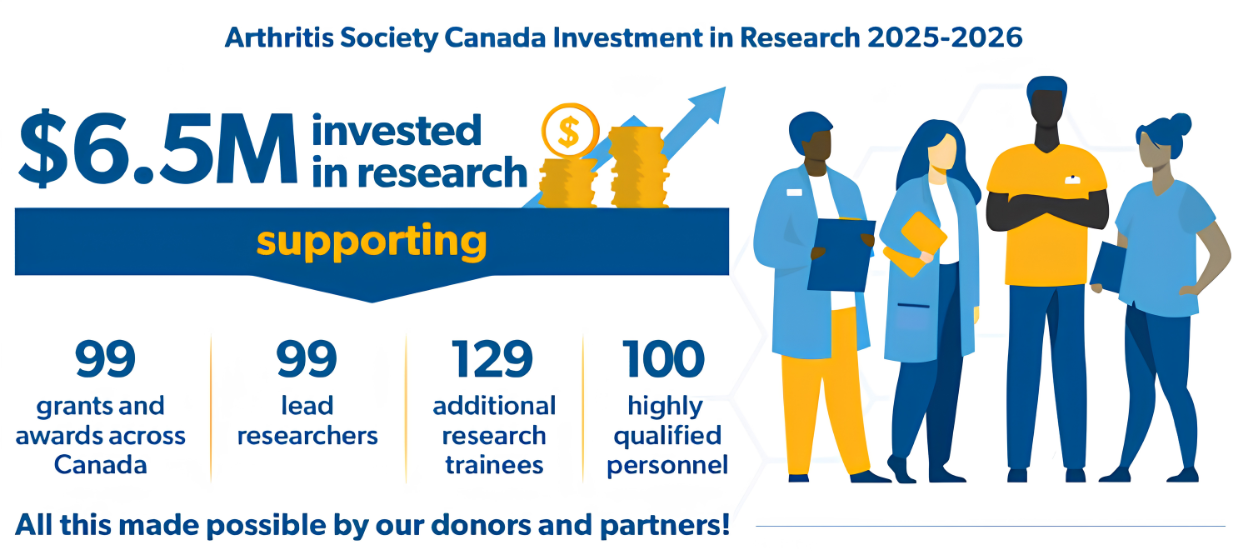
Through the trust and support of our donors and partners, Arthritis Society Canada is Canada’s largest charitable funder of cutting-edge arthritis research, investing more than $250 million in research projects since our founding – projects that have led to breakthroughs in the diagnosis, treatment and care of people with arthritis.
The investments we make in scientific research and discovery seek to spark new ideas and careers in arthritis research, supporting talented investigators and trainees seeking to understand the causes of arthritis and to develop innovative solutions to improve quality of life for those living with arthritis, on the road to finding a cure. We hold ourselves to a high standard when selecting which research projects have the potential to generate the most impact in solving the unanswered challenges of arthritis. Through a gold-standard expert grant and award review process, we invite talented researchers from across the country to submit proposals for consideration by a panel of subject matter experts in discovery research and clinical care, as well as people with lived experience of arthritis.
In the sections below, you’ll find highlights of the impact our researchers are making, as well as more details on our current research funding programs.
Research advances are transforming how arthritis is diagnosed, treated and prevented.
Thanks to the generosity and vision of our donors and supporters, Arthritis Society Canada is the leading charity in funding life-changing arthritis research across the country. With this crucial support, our brightest minds are answering the most pressing research questions spanning the many types of arthritis. Whether working in the lab, the clinic or alongside people living with this devastating disease, researchers are turning your support into discoveries to relentlessly fight the fire of arthritis. Here are some of the many advances made possible in 2025.

A window of opportunity in childhood arthritisDr. Susanne Benseler, University of Calgary, and Dr. Rae Yeung, The Hospital for Sick Children, on behalf of the UCAN CAN-DU and UCAN CURE consortiaThe finding: In the international Understanding Childhood Arthritis Network (UCAN) study of 130 children with non-systemic juvenile idiopathic arthritis (JIA), which was enabled by a first-of-its-kind partnership of Dutch and Canadian funders including Arthritis Society Canada, researchers found that starting biologic medication earlier can significantly affect treatment success. 83% of children who started biologics within 6 months of their initial symptoms achieved inactive disease, compared to 57% of those who waited 13–24 months. For every month of delay, the odds of still having active arthritis after six months of treatment increased by a relative 9%, revealing a critical “window of opportunity” to better manage childhood arthritis. The future: These findings could help doctors better understand the best time to begin biologic therapy in children with non-systemic JIA. This research may help inform medication access challenges and guide treatment discussions, potentially improving disease control for children who proceed with biologics and reducing unnecessary delays in the decision-making process. This is a critically important step towards a cure for childhood arthritis. |

Potential biomarkers for psoriatic arthritis developmentDr. Omar Cruz-Correa and Dr. Dafna Gladman, University Health NetworkThe finding: 30% of patients with psoriasis go on to develop psoriatic arthritis (PsA), but there is currently no reliable way to predict who will be affected. By studying microRNAs (miRNAs) – molecules that control which genes are active – researchers identified two molecular markers (miR-190a-5p and miR-26b-5p) that were consistently lower in PsA patients. When these markers are reduced, genes involved in bone formation and repair pathways are disrupted, potentially explaining how joint damage occurs in PsA. The future: If these markers are confirmed as early warning signs of PsA, this research could lead to screening tests that help identify which individuals with psoriasis are at high-risk of developing PsA. This could also allow doctors to start treatments before permanent joint damage occurs. |

A potential therapy for painful spine arthritisDr. Lisbet Haglund and trainees Matthew Mannarino (PhD candidate) and Dr. Hosni Cherif, McGill UniversityThe finding: Researchers showed the potential of a new combination treatment for painful spine arthritis in a study of mice with low back pain resulting from deteriorated disks in the spine. The treatment, given by mouth, targets senescent cells – “zombie” cells that resist dying, build up with age, and release substances that can trigger deterioration in nearby tissues. The treatment successfully removed these cells, reduced signs of pain, and improved bone health in the mice, demonstrating a promising level of safety. The future: By establishing its potential in a preclinical model of disease, the researchers have laid the foundation for further clinical study to determine if this treatment approach could be safe and effective in humans with painful back conditions like arthritis. |

A deep dive into the genetics of lupusLead authors, Dr. Raffaella Carlomagno, Lausanne University Hospital, and Melissa Misztal (MD candidate), Western University, and Arthritis Society Canada-supported author, Dr. Linda Hiraki, The Hospital for Sick ChildrenThe finding: For the first time, two pivotal studies of the genomes of nearly 1,500 children and adults with systemic lupus erythematosus (SLE) identified specific genetic variants associated with (i) disease severity in adult-onset lupus over time, and (ii) younger age at diagnosis and risk of childhood-onset lupus. The future: With further validation, these genetic markers may help deepen our understanding of the genetics of lupus at all ages and predict disease severity in adults. It could also support individualized treatment plans with the goal of reducing life-threatening organ damage. |

Preventing hip osteoarthritis in young adultsDr. Luke Johnson, and Drs. Kishore Mulpuri and David Wilson, University of British ColumbiaThe finding: Researchers used a MRI technique called T1ρ (T1 rho) to compare cartilage health in young people with and without Legg-Calvé-Perthes disease (LCPD), a childhood hip condition that “heals” naturally but often leaves permanent hip deformities, which can increase risk of osteoarthritis. While hips without LCPD developed cartilage normally as teens aged, LCPD hips showed progressive cartilage deterioration through the teenage years. The future: These results provide a better understanding of early cartilage changes in LCPD that may lead to pain and early-onset osteoarthritis. This is essential for creating more thorough preventative management approaches to improve long-term quality of life for people with LCPD deformity. |

Improving rheumatoid arthritis self-management through digital coachingDr. Linda Li, University of British Columbia – Arthritis Research CanadaThe finding: Researchers tested whether combining Fitbits, an activity tracking app, and remote physiotherapist phone coaching could help 131 people with rheumatoid arthritis (RA) better self-manage their condition. After 27 weeks, participants showed significant improvements in their confidence to manage their RA, including improved RA disease activity and self-reported walking habits, as well as reduced fatigue and depression, compared to controls. The future: Remote digital health coaching and self-monitoring tools can enhance individuals’ ability to engage in self-care activities and deliver real clinical benefits without in-person visits, potentially transforming arthritis care across Canada’s vast geography. |

Estimating the impact of investments in education and exercise for people living with osteoarthritisDr. Darren Mazzei and Dr. Deborah Marshall, University of Calgary and Arthritis Research CanadaThe finding: Researchers modeled the impact of public funding for Good Life with osteoArthritis in Denmark (GLA:D), a standardized exercise and education program to help people with hip or knee osteoarthritis as they wait for an orthopedic consultation for a total joint replacement in Alberta. Public investment in this program would pose an affordable way to serve 12,500 Albertans and save $8.5 million by avoiding 1,300 joint replacement surgeries in year one. The future: This research makes a case for governments to publicly fund the GLA:D program to all patients waiting for knee or hip replacement consultations. The result would be improved equitable access to evidence-based care, prioritized surgeries for those who are truly end-stage, reduce wait times, and add pain-free years to peoples’ lives in Alberta, and potentially beyond. |

Improving treatment response in axial spondyloarthritisDr. Addison Pacheco and Dr. Robert Inman, Schroeder Arthritis Institute, University Health NetworkThe finding: Blood analysis of 30 people with axial spondyloarthritis revealed immune signatures that help predict whether patients will respond to secukinumab, a biologic therapy that blocks inflammation-driving IL-17A-producing cells. Non-responders had more of these cells before treatment and showed enhanced “type 1 interferon” activity (a different inflammatory pathway) after therapy, suggesting their inflammation operates through multiple pathways that secukinumab alone may not control. The future: These immune signatures could help doctors predict which patients will benefit from secukinumab before starting treatment, avoiding months of ineffective therapy for the 40% who do not respond. This research also points toward more immune complexity in axial spondyloarthritis than previously recognized and highlights the need for precision therapeutics in this disease. |

Females with osteoarthritis are more likely to develop cardiovascular diseaseDr. Anthony Perruccio, Schroeder Arthritis Institute, University Health NetworkThe finding: By examining data from thousands of adults with and without osteoarthritis (OA), researchers found that females with OA had a 90% higher risk of developing cardiovascular disease within six years, compared to females of the same age without OA. This increased risk was above and beyond what routine risk prediction tools would suggest and was partially linked to levels of inflammation in their bodies. This relationship was not seen for males. The future: This research highlights the importance of connecting OA and cardiovascular disease as a women’s health issue and a need to further study the causes of the increased risk. It could lead to better ways to prevent cardiovascular disease and associated deaths in females with OA – possibly by reducing inflammation. |

A potential new drug target for hip osteoarthritisLead author Jingyi Huang (PhD candidate), and Arthritis Society Canada supported author, Dr. Guangju Zhai, Memorial University of NewfoundlandThe finding: Researchers analyzed cartilage from over 100 people with and without hip osteoarthritis (OA) and identified 179 genes that behave differently in hip OA compared to healthy joints. Eight key “hub genes” were pinpointed as central players in the disease, with most involved in disrupting the normal formation and balance of collagen – the main structural protein that keeps cartilage healthy and strong. One hub gene called SDC1 emerged as a promising new drug target as it is already classified as “druggable”, with some cancer medications targeting SDC1 already in clinical trials. The future: This molecular roadmap could accelerate the development of targeted OA treatments by repurposing existing drugs or designing new ones that address the root causes of cartilage breakdown rather than just managing symptoms. |
Research advances are transforming how arthritis is diagnosed, treated and prevented.
Thanks to the generosity and vision of our donors and supporters, Arthritis Society Canada is the leading charity in funding life-changing arthritis research across the country. With this crucial support, our brightest minds are answering the most pressing research questions spanning the many types of arthritis. Whether working in the lab, the clinic or alongside people living with this devastating disease, researchers are turning your support into discoveries to relentlessly fight the fire of arthritis. Here are some of the many advances made possible in 2024.
|
|
|
|
|
|
|
|
|
|
|

 Preventing heart disease in people with psoriatic arthritis
 Improved access to rheumatoid arthritis care
 The knee’s fat pad – a complex player in osteoarthritis
 Joint damage after a sprained ankle
 How seeing green light can reduce joint pain
 Using AI to speed up osteoarthritis diagnosis and monitoring
 Purple Butterfly: A tool to support lupus patients
 Joint replacement surgeries in newcomers
 Fatigue – a core concern in childhood arthritis
Research advances are transforming how arthritis is diagnosed, treated and prevented.
Thanks to the generosity and vision of our donors and supporters, Arthritis Society Canada is the leading charity in funding life-changing arthritis research across the country. With this crucial support, our brightest minds are answering the most pressing research questions spanning the many types of arthritis. Whether working in the lab, the clinic or alongside people living with this devastating disease, researchers are turning your support into discoveries to relentlessly fight the fire of arthritis. Here are some of the many advances made possible in 2023.
|
|
|
|
|
|
|
|
|
|
 Improving access to osteoarthritis care for diverse women
 Blocking inflammation in gout
 Understanding joint lubrication in osteoarthritis
 A decade of progress in childhood arthritis
 Predicting persistent osteoarthritis pain
 Signs of ankylosing spondylitis in the blood
 Hip cartilage health in young adults
 Sensitivity to pain from physical activity
 Particle-based drug delivery for osteoarthritis
 Intriguing similarities between systemic sclerosis and cancer
Recent research advances are transforming the future of arthritis.
Thanks to the generosity and vision of our donors and supporters, Arthritis Society Canada is the leading charity in funding cutting-edge arthritis research across the country. With this crucial support, innovative minds are answering the most pressing research questions spanning the many types of arthritis. Whether working in the lab, the clinic, or alongside people living with arthritis in their everyday lives, researchers are turning your support into discoveries to relentlessly fight the fire of arthritis. Here are some of the many advances made possible in 2022.
|
|
|
|
|
|
|
|
|
|
 Blood markers for rapid osteoarthritis progression
 How a gut protein and bacteria promote inflammatory arthritis
 How to promote knee health after injury to prevent osteoarthritis
 Toward personalized treatment for rheumatoid arthritis
 Cannabis chemical to reduce joint pain and inflammation
 A new drug target in inflammatory arthritis
 The winding paths in childhood arthritis treatment
 Potential biomarkers for spine degeneration
 Genetic links between systemic sclerosis and cancer
 People with arthritis need more information and support
Research advances from 2021 are transforming the future of arthritis.
Thanks to the generosity and vision of our donors and supporters, Arthritis Society Canada is the leading charity in funding cutting-edge arthritis research across Canada. With this crucial support, innovative minds are answering the most pressing research questions spanning the many types of arthritis. Whether working in the lab, the clinic, or alongside people living with arthritis in their everyday lives, researchers are turning your support into discoveries to relentlessly fight the fire of arthritis. Here are some of the many advances made possible in 2021.
|
|
|
|
|
|
|
|
|
|
 Childhood arthritis impacts school performance
 Impact of COVID-19 on young workers with arthritis
 Life after youth sports injury
 Better healthcare for inflammatory arthritis
 Mimicking osteoarthritis in the lab
 Three new osteoarthritis subtypes
 Investing in exercise for osteoarthritis
 Mental health and gout
 Toward a new treatment for spondyloarthritis
 Putting the brakes on inflammation
Research advancements of 2020 that are transforming the future of arthritis.
Thanks to the generosity and vision of our donors, Arthritis Society Canada is the leading charity in funding cutting-edge arthritis research across Canada. With this crucial support, innovative minds are answering the most pressing research questions spanning the many types of arthritis. Whether working in the lab, the clinic, or alongside people living with arthritis in their everyday lives, researchers are turning your support into discoveries to help improve care for people with arthritis today, while searching for a cure for tomorrow. Here are some of the many advances made possible in 2020.
Immune reactions in systemic lupus erythematosus and the antiphospholipid syndromeYann Becker, Centre de Recherche du CHU de Québec – Université Laval
The finding: Mitochondria are small structures inside cells that are considered to have evolved from bacteria. If cells are damaged and mitochondria are released, the body’s immune system can mistake them for foreign threats and mount an immune response as if there was an infection. This immune overreaction takes place in several diseases such as systemic lupus erythematosus (SLE), an autoimmune form of arthritis, and the antiphospholipid syndrome (APS), a disease often associated with SLE. Yann Becker identified several mitochondrial features that are recognized by the immune defenses of people living with SLE and APS. Anti-mitochondrial antibodies that occur because of this defence may be associated with specific symptoms of the disease. The future: At this time, there are no clinical tests that can diagnose SLE or predict how symptoms progress. This study will help to improve understanding of the role of mitochondria in the development of autoimmune diseases as well as the design of new tests to better diagnose SLE. |
How parents influence kids undergoing arthritis treatmentYvonne Brandelli, Dalhousie University
The finding: While childhood arthritis can cause debilitating pain on its own, parents can be further disheartened by having to administer treatments to their kids that can also cause pain or discomfort. Yvonne Brandelli found that parents who were more afraid of their child’s pain, especially when their child was receiving more painful treatments like self-injections, struggled more with sticking to the recommended treatment plans. The future: These findings highlight a need for psychological support and resources for parents of children with arthritis to help them recognize and deal with how they feel about their children’s pain to ensure they and their child receive the best treatment possible. |
Removing “zombie” cells to reduce pain and degeneration in the spineDr. Hosni Cherif, McGill University
The finding: Degeneration of parts of the spine can cause debilitating back pain and osteoarthritis (OA). While some treatments can help manage the pain, there is no cure or way to prevent the degeneration from progressing. “Zombie” or senescent cells – ones that have stopped multiplying but haven’t died – may play a key role in spine degeneration. Dr. Hosni Cherif was the first to find that RG-7112, a synthetic drug, and o-Vanillin, a natural compound, triggered changes that helped new, healthy cells to grow and at the same time, killed senescent cells. The future: These findings could lead to new drugs for back pain that slow the degeneration of the discs and reduce pain. |
Predicting cardiovascular risk in people with psoriatic diseaseDr. Lihi Eder, Women’s College Hospital
The finding: Psoriatic disease (PsD) is a chronic inflammatory skin and joint disease that includes psoriasis and psoriatic arthritis. People with PsD are more likely to develop cardiovascular diseases, such as heart attack and stroke, but doctors need a better way to predict which patients have the highest risk. Dr. Lihi Eder and Keith Colaço discovered abnormalities in lipid particles and cardiac biomarkers in patients with psoriatic diseases. The future: These biomarkers, when added to traditional risk factors for cardiovascular disease, such as high blood pressure or smoking, could identify patients that will go on to develop disease in the next 5-10 years. The ability to identify high risk patients will lead to better care and reduced cardiac risk. |
Investigating a new treatment for sclerodermaDr. Andrew Leask, University of Saskatchewan
The finding: Scleroderma is characterized by a build-up of tough scar-like fibrous tissue in the skin. A type of cell called the fibroblast is responsible for the overproduction of collagen and the development of tough scar tissue (a process called fibrosis). Dr. Andrew Leask found that inhibiting a protein inside the fibroblast, called YAP1, can block genes that are responsible for fibrosis. The future: This provides early clues into a new area for investigation – how drugs that target YAP1 can be used to reverse fibrosis, leading to more treatment options and improved quality of life for people with scleroderma. |
Reducing the risk of flu in people with rheumatoid arthritisDr. Ines Colmegna, The Research Institute of the McGill University Health Centre
The finding: Patients with rheumatoid arthritis (RA) are more prone to infections than people without RA. One of the most frequent causes of infections in RA is seasonal influenza or flu. Dr. Ines Colmegna led the first study to show that the use of a high dose influenza vaccine provides better protection from the flu in RA patients compared to the standard dose vaccine. The future: These results support the use of the high dose influenza vaccine for people with RA of any age. This may enhance vaccine induced protection and lower the risk of influenza in those patients. |
Improving joint protection for people with hand osteoarthritisDr. Joy MacDermid, Western University
The finding: Joint protection programs help patients with hand osteoarthritis alleviate pain and improve function. In a comprehensive review of the literature, Pavlos Bobos found challenges with these programs, for example, a lack of consistency, few are evidence-based, many are outdated, and few use assistive devices. Dr. Joy MacDermid created a new way of measuring the impact of daily tasks on hands using a sensor embedded in a fake fingernail. The future: A better understanding of the forces used in daily tasks will support the development of new joint protection programs to improve hand function and preserve joints. |
A triple threat for seeing joint damage in rheumatoid arthritisDr. Sarah Manske, University of Calgary
The finding: People with rheumatoid arthritis (RA) have swelling and bone damage in their joints, but how that damage starts and gets worse is unclear. Dr. Sarah Manske developed techniques to put together images from different times and different tests (e.g., MRI, ultrasound and CT) to better measure the changes that are happening in the bones of people with RA, and the inflammation that might be causing those changes. The future: Greater use of imaging tools to detect inflammation that is not seen on clinical examination will help clinicians determine how RA is progressing, including if people are at risk for further bone damage, and if so, what strategies can help to minimize joint damage. |
Cannabis targeting arthritis painDr. Jason McDougall, Dalhousie University
The finding: Many people with osteoarthritis (OA) struggle with effective pain relief. One of the limitations of pain control is that prescribed analgesics, like NSAIDs, treat pain caused by inflammation, and are not effective for neuropathic pain, caused by damaged nerves in the joints. Dr. Jason McDougall identified a natural cannabinoid system in animal joints that is effective in relieving neuropathic and inflammatory pain. He also discovered new cannabis constituents that may help patients better manage their pain. The future: By tapping into the body’s natural cannabinoid system, people with OA may be able to reduce the dose of NSAIDs needed to treat joint pain and inflammation, leading to fewer side effects. |
How rheumatoid arthritis starts in a high-risk populationDr. Vidyanand Anaparti, University of Manitoba
The finding: First Nations people have elevated rates of rheumatoid arthritis (RA), but it’s not clear why. Dr. Vidyanand Anaparti is studying First Nations people with a high risk of RA as they start to show symptoms to determine what factors precede or aid in the onset of the disease. One factor is microRNAs, which are “cellular switches” that turn genes on and off. Dr. Anaparti identified that first-degree relatives of people with RA have altered levels of microRNAs and how they are expressed varies depending on the type of immune cell. Another cellular switch is called methylation, a biochemical process that controls gene expression. Dr. Anaparti found that the methylation of specific genes in RA patients was different and may play an important role in the development of RA. He also identified that the levels of metabolic markers (such as vitamin D, omega-3 and omega-6 fatty acids, oxylipins, and adipokines) are changed in high risk, first-degree relatives of people with RA. The future: Dr. Anaparti found that microRNAs and methylation have a direct influence on the expression of genes involved in RA. These findings are not unique to the indigenous population and may generally help to identify people at risk of developing RA. |






Research advancements of 2019 that are transforming the future of arthritis.
Thanks to the generosity and vision of our donors, Arthritis Society Canada is the leading charity sparking new ideas and careers in arthritis research across Canada. With this crucial support, innovative minds are answering the most pressing research questions spanning the many types of arthritis. Whether working in the lab, the clinic, or in the community, researchers are turning donor support into discoveries that both enhance care for people living with arthritis today and open the door for the new treatments and cures of tomorrow. Here are some of the many advances you made possible in 2019.
Advancing drug delivery for osteoarthritis
|
An innovative cell therapy for osteoarthritisDr. Sowmya Viswanathan, University Health Network
The future: This groundbreaking discovery lays the foundation for larger clinical trials on the path to new treatments. Reducing joint inflammation and pain while restoring mobility and quality of life with a single injection of cells could give people with knee OA back the life they’re missing. |
First Nations and Métis patient preferences for rheumatoid arthritis managementDr. Glen Hazlewood, University of Calgary
The future: These insights will help healthcare providers build relationships with their First Nations and Métis patients based on trust and effective communication. This is expected to encourage shared decision-making in a culturally safe environment to improve RA treatment in this population. |
Preventing a life-threatening complication of sclerodermaDr. Sabrina Hoa, Jewish General Hospital – Lady Davis Institute
The future: This suggests a promising “window of opportunity” to treat ILD early on, when it is mild, to prevent its progression to a life-threatening complication. With further study, this treatment approach could save lives for those with scleroderma. |
Vitamin D and rheumatoid arthritis?Dr. Vidyanand Anaparti, University of Manitoba
The future: This research provides early clues into a new area for investigation – how vitamin D might be involved in the development of RA in this population. |
Wearable technology to measure function before knee replacementDr. Matthew Teeter, Lawson Health Research Institute
The future: With further development, this technology could be used to help patients manage their expectations and inform their post-operative recovery and rehabilitation plans. |
Artificial intelligence to guide treatment in childhood arthritisDr. Simon Eng, The Hospital for Sick Children
The future: This new approach will shape clinical practice and inform tailored treatment decisions to keep children with arthritis healthy. |
Depression and anxiety in lupusDr. Zahi Touma, University Health Network
The future: Bringing attention to the high prevalence of depression and anxiety in people with lupus and providing reliable tools to help healthcare providers screen for them can help ensure patients get the timely psychiatric care and support they need. |
Earliest joint changes on the path to post-injury osteoarthritisDr. Steven Boyd, University of Calgary
The future: Knowing how the bone is lost or damaged in the injured joint in the months immediately after an ACL tear suggests that efforts to rehabilitate the joint should begin early after injury to prevent future OA. |
Long wait times for multidisciplinary pain treatmentSimon Deslauriers, Université Laval
The future: This research highlights a gap in access to timely and effective care and identified several barriers to be addressed to improve access to comprehensive pain management services. |
 The finding: While many scientists are working towards new treatments for osteoarthritis (OA), drugs that circulate throughout the whole body often have undesirable side effects. To help address this, researchers developed a new delivery method for an anti-inflammatory drug by converting it into tiny particles that could be injected directly into the joint.
 The finding: Treatments to limit the impact that osteoarthritis (OA) has on lives are limited. Cell-based therapies could hold the key but have not yet been proven to be safe or effective. Canada’s first clinical trial on cell therapy for advanced knee OA revealed that it could be a safe approach to reducing joint pain and improving function, likely by combatting inflammation.
 The finding: Rheumatoid arthritis (RA) is more common in First Nations and Métis Peoples than in non-Indigenous populations. However, little is known about the preferences of Indigenous patients regarding RA management. Researchers found that First Nations or Métis patients with RA at rheumatology clinics in Southern Alberta accept a holistic approach to managing the physical, mental, emotional and spiritual aspects of living with RA. Their preferences for medication were also influenced by clinical, familial and societal factors.
 The finding: Scleroderma (sometimes called systemic sclerosis) is a rare autoimmune disease that involves a build-up of tough scar-like tissue in the skin and sometimes other organs. If the lungs are involved, people can develop a complication called interstitial lung disease (ILD), which can be fatal. Researchers found that drugs that suppress the immune system in people with mild ILD help preserve lung function and prevent ILD progression.
 The finding: Wearable sensors may become the future of preoperative assessment of people with arthritis preparing for knee replacement surgery. Researchers found that combining wearable sensors to track knee movement with a form of artificial intelligence called machine learning could be used at pre- and post-operative appointments to classify people according to their likelihood of improving their knee function.
 The finding: Some children have mild forms of arthritis, while others can have forms with devastating impacts that last into adulthood. It’s hard to predict which children might be able to avoid unnecessary treatments and side effects. Researchers discovered an algorithm using artificial intelligence that can predict how childhood arthritis will behave.
 The finding: Lupus, or systemic lupus erythematosus (SLE), is a serious inflammatory disease that can involve the joints and many organs, including the nervous system. This can lead to several mood disorders that can often go undiagnosed. Researchers found that simple patient screening questionnaires could be helpful in identifying people with lupus who may have depression or anxiety and found that these conditions were present in up to half of all lupus patients.
 The finding: Tearing the anterior cruciate ligament (ACL) in the knee is a common sports injury that increases the risk of developing knee osteoarthritis (OA). In more detail than ever before, researchers were able to use advanced medical imaging to visualize some of the earliest changes to the bones in the knee joint after an ACL injury.
 The finding: People with arthritis can receive comprehensive pain management services in pain clinics, where multiple healthcare providers provide coordinated care for chronic pain. Pain clinic services can improve patients’ quality of life but often have long wait times. Researchers found that about a third of people with arthritis in Quebec waiting to be seen at a pain clinic waited longer than 6 months before their first appointment.
NOTE: “Consumer Favourite” was selected through an online survey of the Arthritis Society Canada Online Consumer Panels, which include people with lived experience of arthritis volunteering their perspectives.