Jessica Taylor, a 27-year-old nurse from London, Ontario, has lived with osteoarthritis since her teens. Painful flare-ups can make long hospital shifts impossible, and while her employer provides accommodations, stepping back from patient care is never ideal.
 “I’d rather be out there, completing my rounds and caring for patients,” she says. “That’s where I’m needed most.”
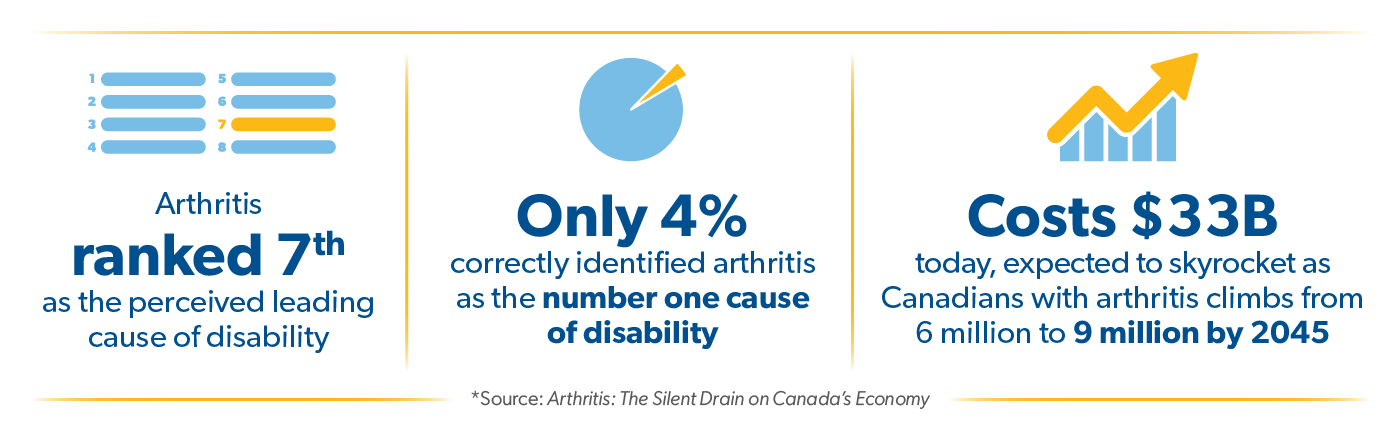
Her story isn’t unique. Arthritis is the number one cause of disability in Canada, and yet, only 4% of Canadians know this to be true. An alarming new white paper by Arthritis Society Canada and Leger Healthcare titled “Arthritis: The Silent Drain on Canada’s Economy” reveals this troubling disconnect between public perception and reality.
In fact, arthritis was ranked seventh on the list of perceived leading causes of disability, far behind conditions like heart disease and cancer. That perception gap matters.
Arthritis already affects 6 million Canadians and drains at least $33 billion annually from the economy in healthcare costs and lost productivity. Missed workdays, reduced hours, and people forced into early exits from the labour force all contribute to this economic burden. What’s worse is that this figure is expected to skyrocket as the prevalence of arthritis is projected to grow by 50% over the next two decades, affecting 9 million Canadians by 2045.
“Canadians are feeling the squeeze of today’s economy – rising costs, tariffs, and global uncertainty. Those forces are beyond our control. But one challenge we can address is arthritis,” said Trish Barbato, president and CEO of Arthritis Society Canada. “As the number one cause of disability in Canada, arthritis drains $33 billion from our economy each year by reducing productivity, straining healthcare, and forcing people out of the workforce early. Unlike one-time economic shocks like tariffs or trade disputes, arthritis is a chronic, compounding burden on the economy.”
This burden falls hardest on people at the heart of their prime earning years. Half of Canadians with arthritis are under 65, and one-third are diagnosed before 45. These are years when people are building careers, raising families, and contributing in countless ways to their communities and to Canada’s economy.
 For Diana Gazdar, a 51-year-old Toronto executive, rheumatoid arthritis has shaped her life since her first pregnancy nearly 20 years ago. She manages a demanding role and is open about her condition with her colleagues but says few truly grasp what she experiences.
“They see me on my best days,” she says. “They don’t see the flare-ups, the days when I can’t leave my house, or even my office, because the pain is that debilitating.”
Her words echo the findings of the report: arthritis isn’t just a personal struggle – it’s a national one. And until the perception gap closes, the challenges will keep compounding. When arthritis is misunderstood or overlooked, supports like treatments, workplace accommodations, and arthritis research funding all fall short, creating consequences that ripple far beyond the individual.
As Canada debates tariffs, trade wars, and the pressures of a slowing global economy, this deeper and more costly crisis is already here.
“Canadians take swift, united action when the threat is visible—whether it’s a global health emergency or a trade disruption,” added Barbato. “We need that same urgency now for arthritis. Closing the gap between perception and reality is essential to protect Canada’s workforce and future prosperity.”
The whitepaper calls for a coordinated response across sectors, including increased investment in research, stronger workplace support, better access to diagnosis and treatment, and greater awareness to close the perception gap.
You can make a difference today:
- Read the full whitepaper, Arthritis: The Silent Drain on Canada’s Economy
- Share your input by participating in our survey to help us shape the future of arthritis action.
- Support by donating to help fund research and programs that improve the lives of people living with arthritis.