Young adults face unique challenges when it comes to living with arthritis. Whether it’s finishing school, starting a new job, or navigating relationships, this section will provide coping tips and strategies to help you lead your best life.
Meet Our Young Adult Ambassadors
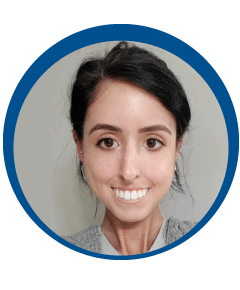
Meet Dina-Marie
Dina-Marie is 25 years old and was diagnosed with scleroderma when she was 19. In her spare time, she enjoys baking, reading and catching up on sleep because “you can never have enough!” Dina-Marie has chosen to share her story in hopes it has an impact on someone else who is going through similar struggles. Ultimately, her message is that no one is alone.
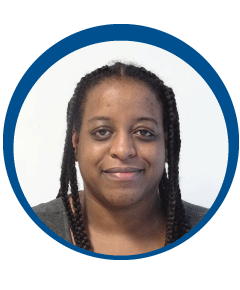
Meet Kiah
Kiah is 25 years old and was diagnosed with SLE (lupus) when she was 17. In her spare time, she enjoys playing The Sims, watching HGTV (because she has a passion for design) and learning Mandarin. To Kiah, this resource provides a source of inspiration as it showcases people living with arthritis and achieving their goals. As she says, “Anything is possible with the right support system.”
Meet Cristina
Cristina is 38 years old and was diagnosed with rheumatoid arthritis and Sjögren’s syndrome when she was 21. In her spare time, Cristina loves reading psychological thrillers, Zumba, cooking, learning about medical cannabis and of course, playing with her son. Through sharing her story, Cristina hopes to inspire young arthritis warriors to live life to the fullest despite chronic illness.
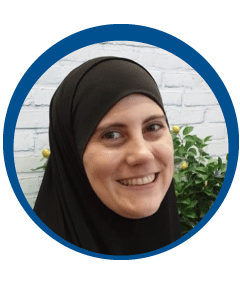
Meet Allyson
Allyson is 35 years old and was diagnosed with ankylosing spondylitis when she was 27. Allyson loves travelling to new places and exploring the outdoors. Through sharing her story, she hopes to help others that may be facing a new diagnosis or who just want to know they are not going through it alone. Allyson wants young adults to know that despite the challenges of living with arthritis, they can still achieve their dreams.


Meet James
James is 30 years old and was diagnosed with ankylosing spondylitis when he was 23. In his spare time, he enjoys cooking delicious food and DJing. Through this resource, James hopes to raise awareness that “arthritic conditions affect adults of all age groups” as this is a step towards “understanding that inflammation causes a lot of pain in people’s everyday life.”

Meet Jennifer
Jennifer is 27 years old and was diagnosed with axial spondyloarthropathy with peripheral involvement when she was 23. In her spare time, Jennifer enjoys hiking, canoeing, kayaking, cross-country skiing, snowshoeing, skating, traveling and just about anything involving nature. Jennifer believes that her story is well worth sharing if her experiences can help others in any way.
Meet our Interviewers

Joy is 32 years old and was diagnosed with SLE (lupus) when she was 22. In her spare time, she enjoys dancing, singing and playing guitar. Joy has chosen to be an interviewer as she found it challenging to access peer support after her diagnosis 10 years ago. Ultimately, she hopes that this resource will serve as a source of support for young adults living with inflammatory arthritis.
Adjusting to Life Changes
Since being diagnosed, have you had to make any major life adjustments? If so, what were they and what strategies helped you cope with these adjustments?
I find that I have become more relaxed and not living in fear. A lot of people say, “Oh, I’m just going to wait for a few years until I’m more stable, then I’ll do this, do that.” I have become one of those people that when an opportunity comes up, I kind of just jump on it. I did five years of undergraduate education. So, in my fourth year, I got an opportunity to go to England to do an internship and I took the opportunity and went. My mom was like, “Why not just wait a year? Then when you graduate, you could possibly live there?” And I was like, “Anything could happen in a year.” So, I just went for it. I figured out everything I needed to get there, and I just moved over there for a few months. I became more spontaneous that way, where I just live in the moment, and do things that truly make me happy versus holding back on that happiness for material gains or to make other people happy.
Jillian: I think one of the biggest adjustments was just being in my mid-twenties, enjoying the best part of life, and having to step it down a notch. It definitely impacted my social circle too. That was what it was all about, going out to the cool places in Toronto and the restaurants, going for drinks after work. It really was hard at the beginning. I feel like I missed out on a lot. And even when I was around, I was so uptight at the beginning, and I still am sometimes, because I’m like, “I don’t want to get sick” and “I have to go to bed now. I’m going to get really run down if I don’t.” That’s kind of my mindset now, which is sometimes a little annoying.
I think the biggest sacrifice was just that kind of stuff. Missing out on things with my friends and having to take a back seat a bit. But at the same time, it did probably really help me get into remission. I’ve, you know, concentrated on different things like working out. So it’s the pros and cons. But I think that one of the biggest things was just being 25 and, instead of celebrating, I was crying at home because I couldn’t even go out for my birthday, and I just always wanted to go home. I would leave Toronto every weekend and my friend would get to party in our condo or go out with friends, and I’d just go home and cry at my mom’s. So I feel like I lost a little bit in terms of a couple of years. But I also made the most of my twenties that I could, and I had the best times with my friends when I could.
Allyson: Oh wow. Yeah, I think my life just got turned upside down. Before I got sick I was very career focused and just work, work, school, work. That’s it. That was my focus. After I got sick and I couldn’t do that job anymore–like I just couldn’t do it, I didn’t have the energy to do it–I just felt, literally, what is my purpose in life? It made me evaluate what I am doing and why am I here. That’s when I actually turned to religion as well. I felt like I had to find a different way to approach my whole life. I literally changed my life completely after that. That was definitely the biggest turning point I’ve had. And yeah, like I’ve said, even with my career, even though it’s going sort of in the same areas I wanted to initially, I think that socially, my family, everything, my priorities changed a lot. From strictly career to like, okay there are other things more important in life than just your career and your job. I would say my advice is that it’s not hopeless and seeing a different path for yourself might actually be a positive thing. So even though you’re sick and it’s hard and it’s difficult and a struggle, it might be the thing that you need to make positive change. Because it definitely was for me. It forced me to make a lot of positive change for myself.
Arthritis and Mental Health
Jillian: I think more so at the beginning, it definitely impacted me. Because I was so terrified. Because I looked things up and I Googled things….I just went to worst-case scenario, which I definitely tend to do. I have pretty bad anxiety and it really got worse after my friend died. And then with this diagnosis I thought, “My friend died, I have RA – like, who gets this? Who deals with this? Why am I?”
I feel like at the beginning it was pretty rough. And you know, now that I’ve kind of gotten into a groove and the swing of things it’s been good, but the thing that’s actually crept up lately is just the conversation of kids. It kind of brings back some severe stress. Mentally, I’m like, “do I want to do this?” I don’t know. I’m so petrified to come off of these meds. And what if I flare up? And what if I can’t hold my kid? I just go all over the place. So I find that is definitely, mentally, really tough. And there’s not much I can do, so again, I just try to meditate and work out to de-stress. But it has definitely impacted my mental health.
Dina-Marie: How it impacted me mentally and physically is within my relationship. It has affected the way I view myself in relationships, if that makes sense. In my eyes, I sometimes feel that all people tend to see of me is the physical attributes (just the arthritis and the scleroderma), so I don’t necessarily see myself in the best light when I look at my reflection. And that has impacted my self-image. I have a very supportive partner who would say, “You know, just be quiet, you are beautiful,” and stuff like that. I’ve noticed, especially with scleroderma, the way it has changed my facial structure. It has made everything basically tight because of the excess collagen buildup. My hands don’t function ‘normally’ I suppose, and I have trouble with pretty much everything because the tight skin is all over my body. So I always feel like I can’t fulfill my partner in certain ways like a ‘normal’ woman should be able to fulfill their partner. But that’s more just on the mental side because that’s how I view myself rather than how he views me, if that makes sense. So that is one way it has impacted me tremendously. And it’s going to be a struggle, continuously, to overcome that little barrier.
Choosing a Career Path
Jennifer: Starting university, my goal was to obtain my Honours Bachelor of Social Work degree. Despite arthritis, I achieved this. It definitely came with its set of struggles as I had to learn how to manage on-campus classes, homework, housework, relationships, medical appointments and symptoms. Luckily, I spoke to certain professors who were incredibly understanding and helpful when needed. Not all professors are like this though, so I would highly recommend signing up with the accessibility services at your college or university in order to get accommodations or additional support throughout your academic journey. They have a legal obligation to allow students with disabilities or health conditions to receive said services and opportunities.
As I approached the end of my undergrad, I decided to pursue my studies in the Master of Social Work program at the same university in order to open doors of opportunities. Again, arthritis did not stop me from achieving this. I realized however, during this time, that I likely would not be able to work in my field necessarily to the same extent as some of my “healthy” peers. Working full-time was exhausting and made it almost impossible for me to have a life outside of work. As a result, I started working part-time only and eventually, I was able to find two or three part-time jobs that allowed me to work from home, with a flexible schedule, or with workplace accommodations. This allows me to modify my schedule in order to work around my medical appointments and treatments, all while continuing to work in the field that I love. If you are struggling at work, it may be a good idea to speak to your employer regarding possible workplace accommodations so that you can continue doing the work that you do.
There are many different ways to achieve your goals, despite having limitations. Asking for some workplace accommodations or accessibility services are sometimes essential in order for you to become the student or worker that you want to be.
When I was younger, I was debating between being a Child Psychologist or an Archeologist, but being diagnosed with lupus, I cannot be out in the sun too long and I cannot overexert my body. I always need to be where I have close contact with specialists and doctors, because at any time I could have a flare up. I cannot always be on my feet for a long time because of the joint pains and arthritis. I had to cancel that idea and try to figure out other career paths. I was fortunate that I was only 17 and had not started university yet. So, it was not like I had already invested so much money and time into something and then had to go back to the job board. I decided to study Psychology at the University of British Columbia. I would later add Anthropology and got a double major degree. I am also passionate about helping kids, especially at-risk youth and youth living in poverty to make wise choices and rise above the situations that are holding them back. My dream would be to work at a refugee camp, because then I am still near professional doctors but also able to do what I love. So right now, I am in the process of getting all that experience so that I can find my dream job and travel. It will allow me to do what I want to do but kind of tweak it a little bit, so it meets all the medical needs that I have.
Beforehand, I was working at a law firm a lot of hours. I was finishing my degree part-time. I wanted to finish my degree in accounting and business and then go to law school. [After losing my job due to disclosing my disability,] I’ve nixed the whole law school idea. But I’m really striving to get my accounting designation and working in that area. I have my internship at CIBC now, which is exciting. The [networking event for people with disabilities] I went to was called Lime Connect. They’re really good if you want to work in the business world. I ended up getting an interview for a summer internship. I didn’t actually understand what the job was until probably the third or fourth week that I was working there, but I’m really excited because it is in risk management. It actually deals with understanding laws that regulate the financial industry. So I am now within the legal area, but it also involves numbers and accounting at the same time. So it’s a combination of both. And there are a lot of different roles within this area. So I think it has changed my end goal, but I still have the same passions for the things I liked before I was sick. It has just sort of changed my perspective, and where I want to be, and the types of companies I want to work for. Lawyers are notoriously working a ridiculous number of hours and I knew I couldn’t do that anymore. That wasn’t going to be a reality for me. And even some people try to scare me with accountants, because with the big accounting firms it’s kind of the same thing. But with a lot of networking, you discover a lot of jobs that you didn’t know existed in the field you study.
I’ve found that I’m able to still do what I wanted to do even though I didn’t think I could. But you have to find your niche that works for you and say, “OK, this is what I’m capable of. What are the jobs that I can do in this area that are still going to allow me to have a work-life balance, where I’m not going to exhaust myself?” I think the biggest thing for people with our type of condition is just understanding your limits. Don’t let go of your passions just because you know you have these limits. You can still pursue them. You might just have to find a different way to do it. Look for companies that take that initiative and want to support people with disabilities. Join networking events with companies that take the initiative to hire people with disabilities and want to accommodate you. Look into the companies you apply for and be selective. I think that’s the best thing and that’s how you are going to have the most positive experience.
James: Well, the first question I asked when I was diagnosed was, “does it affect your ears?” That’s all I really care about. The answer to that is no, so that was nice to hear.
Learning to play the piano has been difficult because it’s a daily routine to get the practice down. I started on that, and then my fingers were in a lot of pain, so I work around it and use computers to do it for me.
[Working from home currently means I don’t] have our office chairs and whatnot, so I’m dealing with ergonomic issues. I had to buy some cushions for my chair. So things like that, comfort at work. That’s always been a struggle. And I just take breaks. At least at my old job, I would take breaks and go for a walk. And I kind [of don’t care if my boss has] an issue with it (laughs). Other than that, it doesn’t affect my ears so I should be okay in that.
Coping strategies
Learning how to manage a chronic health condition takes time and perseverance. In your experience with arthritis, what strategies have helped you the most?
Jennifer: It takes a lot of strength and courage to face this disease every day, both mentally and physically. In my opinion, it’s all about finding the proper balance between listening to your body and not letting the disease stop you from living your life and achieving your goals. Having the right medical team and the proper treatment plan is also essential. It was a trial and error period for a very long time so this process requires a lot of dedication and patience. I managed to find relief with immunosuppressive medicine, disease-modifying anti-rheumatic drugs, corticosteroids and certain vitamins/supplements. I also had to find the right balance between rest and exercise. I had to learn, for example, that one day of activity may signify that I need to spend a lot of time resting the following day. It’s a lifestyle that I had to get accustomed to but over time, I have built a lot of strength and endurance. I usually try to stick to the low-impact forms of exercises.
It’s also about self-care and being kind to yourself. Know that you will have bad days and it’s okay. It’s important to allow yourself to have those bad days. Taking it one day at a time, even one hour at a time is sometimes essential. Music has also been a big motivator for me. Finding the right songs that will help push you and motivate you to keep moving, to keep going, is a great help on very difficult days.
Finally, meeting other young adults who live with similar conditions has also been a great help. Some of them I had the opportunity to meet in-person, but others I’ve only interacted with online, on arthritis-related support groups. Not only can we relate and talk about the ways in which we face the illness and the health care system, but we also tend to find a lot of humour in our struggles. Sharing jokes about living the “arthritic life” has brought a lot of laughter into my world, which has helped me when facing day-to-day obstacles.
Disclosing Your Condition
James: Well, with family it’s been pretty easy and expected. With friends, usually it’s a surprise that someone this young can have arthritis. There’s always a conversation like, “Oh, I thought arthritis was for old people.” Then I guess the other category is employers and work colleagues. It can be very similar to the reactions of your friends, like 1: “What does that mean?”, and then 2: “Wow, I’m surprised that young people have arthritis.” But with work you just have to talk to them and explain “This is how it could impact me at work.” My last job was recording sounds and involved a lot of walking and hiking and travelling. Obviously, if you have a bad day it would make it hard. So I [had to be honest and] told my boss, “If I end up having a bad day and it falls when I have to be really busy, there will be a loss of productivity.”
Cristina: Probably the hardest experiences were in Colombia when I was newly diagnosed, when I got my first job and it required a lot of walking because we went to the disadvantaged communities in the city. I think probably when I felt depression was when my boss, who was one of my previous professors, said, “You know Cristina, I know you are extremely professional and you’re very smart, but I cannot renew your contract because of your disease.” That was devastating. I used to do a lot of research at the university, so one of my mentors said, “Well I have a research assistant position, do you want to take that on?” So that was easier. That was more of a desk job. I didn’t have to go anywhere and I was even able to teach at school. It was really fun. But again, a few days that I was really ill, my boss or my mentor said, “So what now, do I have to hire a part-timer to cover the hours?” Agh, it just felt horrible.
Based on those experiences, I was very afraid of communicating to my employers here in Canada that I have RA. Because I was a new immigrant, I wanted to work. But then the first job, they were so supportive. Then I started feeling more comfortable and thinking maybe Canada was not as bad as back home. I remember, even from my last job, I used to travel a lot. As a dietician I used to go to long-term care homes, I used to go to the hospital. So I kind of wanted a full-time job where I just had to go to one place. Then an opportunity arose to work with the Ministry of Health at that time. I said everything, I told them “you know, I have arthritis,” and they still hired me. I said “really?” Since then, even though they know about my condition, when taking a sick day I still feel that pressure. I have always been very much vocal about my condition and I will fight for it if there was ever discrimination, and they know that. Maybe I had a different experience than others and I’m not afraid of speaking up. But I can see it as being a barrier.
Getting Your Diagnosis
Dina-Marie: I suppose after my diagnosis [of scleroderma] it was a relief because I finally had an answer after months of not knowing exactly what was wrong with me. But when I got my diagnosis, my mother was also in the room so she took it a lot harder than I did, because I had kind of self-diagnosed myself. Okay that’s a lie. I did take it hard, but I didn’t show it on the outside because, to me, I felt like I needed to be strong for my family and my friends who couldn’t quite hide their emotions when I told them this is what I have. So for me to accept it and come to full terms with arthritis and scleroderma, it was more just myself in my room having (it’s going to be sad to say), but having panic attacks at two o’clock in the morning and just having to go through multiple nights and months of basically crying myself to sleep, getting myself to accept that this is okay, that it’s okay to cry, and it’s okay to show weakness as well.
[What do I wish I knew then that I know now?]
One: stay off Google.
Two: listen to your body as much as possible because you are going to want to push yourself to do the things/everything you could do before you were diagnosed but then you will be dreading everything you did because you either are in a flare or you can’t get out of bed because you are just exhausted from overworking yourself the day before. So it’s a balance. Honestly, it’s still a learning experience, and I think it always will be. Just being diagnosed with arthritis and autoimmune diseases, you learn every day. It’s kind of incredible.
Kiah: Yeah, [getting diagnosed] was kind of like this weird feeling. My mom has lupus and she was diagnosed before I was born so I always knew what it was and what most of the symptoms were. Before I was diagnosed, I had swollen joints, pain throughout my body, chest pains, shortness of breath, fever, and a cough. At first the doctors did not even want to investigate SLE [systemic lupus erythematosus] because it is not a hereditary disease. They were looking at everything else because they were like, “well you can’t possibly have gotten it just because your mom has it. The chances of you having it are so slim, let’s not invest our time into that.” I was sent to a rheumatoid arthritis specialist and she said, “I’m just going to test you for it anyways, and if it says negative it says negative.” I was then sent to get tested [for lupus] and it came back positive. This was such a rare thing that happened, and I was not prepared for it. So yeah, it was kind of “I know it’s not the end of the world” because I’ve seen how my mom has lived her life. She has been through so much, yet she has done so much, and it has not really stopped her from having a good life. But it also felt like, “This sucks” because it changes my life plans.
Impact on Family and Social Life
Cristina: My husband has always been supportive. We met on the internet about 15 years ago. When he was planning to travel to Colombia [to see me], that was when I got diagnosed. I told him “You know, you don’t need to deal with this, right? Honestly, this is a lot to deal with.” It was too much. He said he really, really liked me, actually loved me, and said he was not going to give up on me. He helped me a lot. Like, just to bring me here [to Canada]. They are a Pakistani family, so my mother-in-law came to see me and she said “No, we are going to take care of you and we want to make sure that you are going to be well.” Thirteen years later and we all live together, which I think is a blessing because I don’t have the energy to do a lot of things and they help me to cope.
Sometimes a difficulty I have is [with intimacy]. It’s like you are either too tired or too dry, and it hurts. I don’t know if people are comfortable talking about it, but it’s really such an important part of your relationship. So having that communication between me and my husband is key. He tries to be very gentle. It is still to this day a struggle to fine tune that. And one of the major life adjustments, definitely, was having my child [while dealing with] arthritis. I wish I could have more kids but I feel my complications were so bad that if I have another baby, I’m going to die and leave two kids. So, I had to make that decision to not have more children.
Jennifer: Arthritis is not perceived as a young person’s disease, so I did have to spend some time educating my family and friends on the matter. I believe it’s so important to surround yourself with supportive and understanding individuals. However, it’s important to realize that it could be very difficult for someone to understand if they have never experienced it themselves, which at times requires patience. I started experiencing arthritic symptoms after starting university and living on my own (outside of my hometown), so the every-day struggles were rarely witnessed by my family. It was also very scary at times for me and for them, as I was experiencing very unusual symptoms and had no one in the area to tag along with me when I needed to go to the emergency room in the middle of the night.
I also really had to plan when and if I could spend some time with friends since a week filled with schoolwork, on-campus classes and medical appointments often took the best of me and I had nothing left to give. I often felt unable to participate in evening gatherings or certain outings because I was usually out of commission later in the day. Where I could participate, I was often in unbearable pain, which probably did not make me a very pleasant person to be with. Though, through this, you find out who your true friends are and who is really going to be there for you at your worst.
My fiancé is also incredibly supportive and is always willing to help me in any way he can, which I am very grateful for. Arthritis has become a crucial part of both of our lives and in some ways, it really has an impact on the future of our family. For example, the disease and treatments can greatly influence our journey to parenthood. We have a long road ahead of us, but one that I’m sure will definitely be worthwhile.
Positive Impacts
Living with significant health challenges can teach you a lot. What are some of the positive/ empowering things you’ve learned throughout your arthritis journey?
Jillian: You can do what you put your mind to… And I apologize, because I’m walking up a really steep hill right now (laughs). I think [living with RA has] really helped me kind of, I don’t know, not humbled me, but made me realize so many things that people go through and you don’t know that they’re impacted. So I think that’s part of it. It’s just taught me to take care of myself, take care of others and be empathetic. And I guess my mom’s really been my rock. She’s always in my corner saying, “You want to do that? You do that. You want to travel? You want to go work out? You want to apply for that job?” She just says, “Go do whatever you want. Don’t let this hold you back.” So I try to keep that in my mind. That I have to have a career, and do well, and be healthy. And I’ll deal with, you know, what I have, but I think she really has helped me realize all that.
Cristina: So many things. My relationship with my mom was really rocky in the early years. Somehow this condition kind of strengthened that relationship, and I was really grateful for it. I don’t know, it just felt like I kind of met my mom again. I love that part of it. It also taught me to believe in second chances, because my husband gave me a second chance by bringing me here and getting me proper treatment. I found a lot of sensitivity here in Canada… People really are genuinely caring when you bring it up. At least the people I’ve met so far. Let’s say, when I go to Toastmasters and they give me a space to talk about how I cope with my condition. They have found it so empowering for themselves, right? “Oh, you were so young and you still deal with pain. And you are coping with it with a smile, and you laugh and you’re silly.” So, I think you just learn to see, really, a lot of the positives. I learned that a lot of the material things don’t really matter if you don’t have health. I guess the priorities change in that sense. You just appreciate the small things more than anything. And you don’t know about tomorrow kind of thing.
So ya, I think I’m not angry anymore. I was blessed with my boy. I have my child and it brought a deeper love inside of me that I didn’t even know. It’s just different. And I am loving it. The fact that I know I’m tired but I have to keep going, but that’s ok.

Learn tips and strategies to help you manage your arthritis day-to-day, including taking care of your physical and mental health; thriving in school and at work; dating, relationships and intimacy; as well as planning for a family.